
Poquoson Property Tax Records: Choose the Record That Fits?
"Tax record" covers more than one document. It might be a value notice, an assessment card, a bill, a payment entry, or a delinquent balance. Poquoson splits those jobs across city offices. The Assessor handles value and the reassessment process. The Commissioner of the Revenue holds parcel and Land Book information. The Treasurer manages charges, payment history, and balances, so keep the tax year and parcel identifier handy whenever you review a notice or screen.
| Record | What it answers | Poquoson custodian |
|---|---|---|
| Assessment card / value notice | City estimate of real-property value and review route | Assessor |
| Parcel record / map number | Property cross-reference and billing owner-address updates | Commissioner of the Revenue |
| Tax bill | Installment charged for the fiscal period | Treasurer |
| Payment history / ticket detail | Posted payments and account activity | Treasurer inquiry |
| Sales report | Dated residential, commercial, land or all-sale data | Assessor |
| Recorded transfer | Instrument conveying land or an interest | Circuit Court Clerk |
Poquoson's online tools are not one combined screen. An assessment can be current while an ownership change is still working through billing updates, and a payment entry can be current without proving a new deed. Route any follow-up to the office named in the table.
Poquoson Property Tax Records Use a July 1 Value Date
The Assessor treats value as an estimate of probable selling price. Similar properties are appraised under an equality principle. General reassessments run every two years. They fall in odd-numbered years, with July 1 of the assessment year as the valuation date. New construction is assessed as it happens. An improvement can therefore change a record outside the general cycle.
A reassessment notice is not a tax bill. The notice gives an assessed value, and the tax calculation then applies the city's rate plus any relief or exemption status. A value-review appointment is the Assessor route when property facts or comparable evidence call the assessment into question. Keep the notice, property description, and dated evidence together.
The city's Assessor page describes the two-year reassessment cycle and links to sales reports and mapping. It summarizes the program. It does not replace an individual assessment card. Ask the Assessor for exact field-level details.
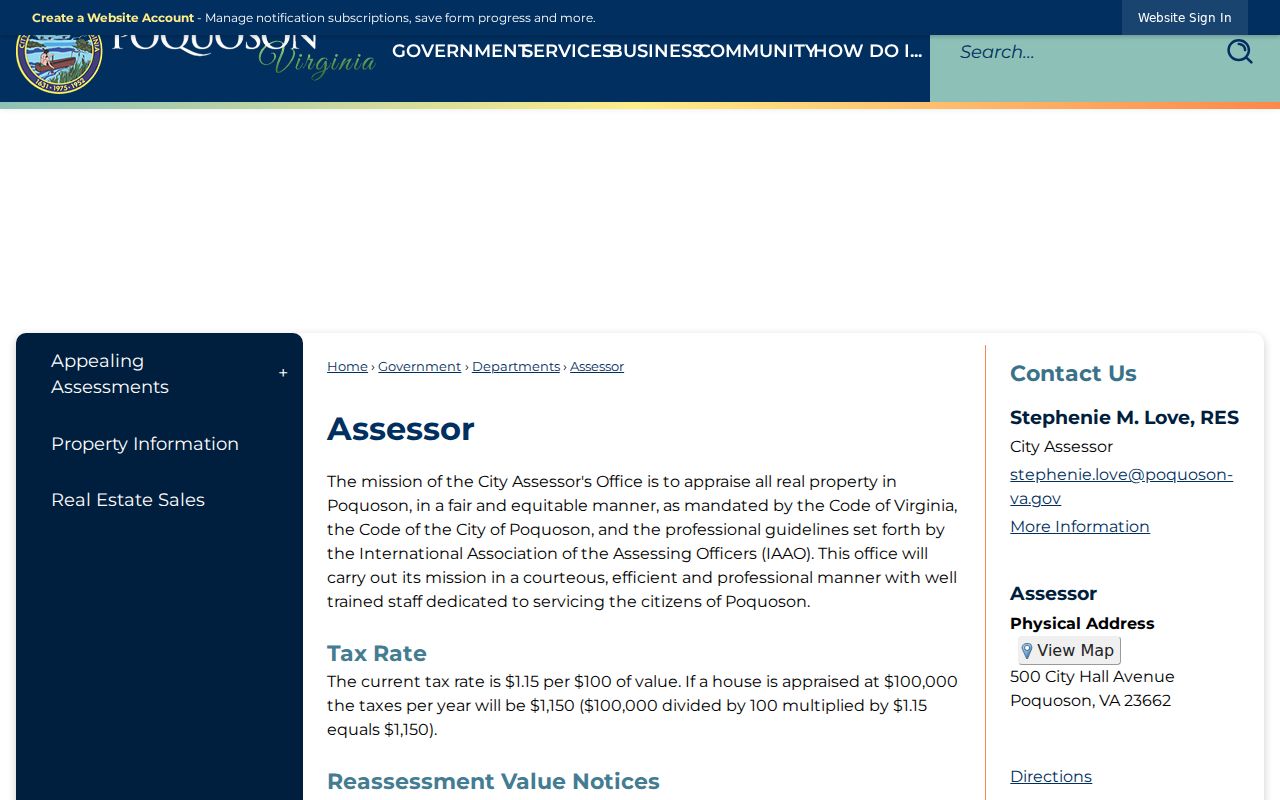
Each assessment in Poquoson keys off a July 1 value date, so a tax notice reflects what the property was worth on that day rather than the day the bill arrives. Confirm the parcel's current card and review procedure with the Assessor at 757-868-3080.
Poquoson Property Tax Records: The $1.15 Rate
Poquoson's published real-estate tax rate for fiscal years 2026–2027 is $1.15 per $100 of assessed value. The rate turns a taxable assessment into a charge. Relief, credits, partial-year issues, and account adjustments come after that. Do not confuse the rate with a sale price. Do not confuse it with a later year's proposal, or a separate online-payment fee.
Match the parcel, tax period, assessed amount, and rate when checking a calculation. A bill that will not align with the notice deserves a question. Ask the Assessor or Treasurer which value and period were used. Skip the neighbor's math. The assessed base or relief eligibility may differ.
The official Poquoson real-estate tax page states the fiscal 2026–2027 rate and the installment rules. That page is the source for the figure. The Assessor remains the route for questions about a parcel's value.
Poquoson Property Tax Records: June 5 and December 5
Poquoson's real-estate tax page lists June 5 and December 5 as the semiannual installment due dates. Per the e-Treasurer information, both bills are listed when assessed. Use the Treasurer inquiry to check the account and payment history. Use the city payment route to submit a payment. Confirm the exact balance on the live system or with the Treasurer before relying on a saved screen.
A missing bill does not stop penalty and interest. Contact the Treasurer if a bill never arrives. When an earlier installment sits unpaid, the online payment rules bar paying current taxes first. Funds go to the oldest taxes due. That ordering can make a payment reduce a different period than expected, so check the ticket detail and ask the Treasurer how the balance was allocated.
Keep the confirmation, account number, and payment date. Credit-card payments carry a 2.5% fee. E-checks have no fee. That fee covers payment processing and sits apart from the real-estate tax rate.
Poquoson Property Tax Records: Online Payment Rules
Poquoson takes online real-estate tax payments through its e-Treasurer service. Card transactions carry a 2.5% charge. E-checks are free. Match the account and ticket to the parcel before paying. A payment route is built to collect money, not to certify that the displayed taxpayer is the current owner of record.
The city attaches delinquent tax liability to the land itself. Settlement should account for taxes due. Any payment applies to the oldest balance first. That rule matters after a recent deed transfer, when buyer, seller, attorney and Treasurer may each be reconciling a different billing period. Ask the Treasurer for the account status. Settlement treatment belongs to the closing professional.
The city's Online Payments page spells out the e-check and card-cost rules along with the delinquent-payment order. Confirm the current amount and accepted choices on the official city portal before submitting money.
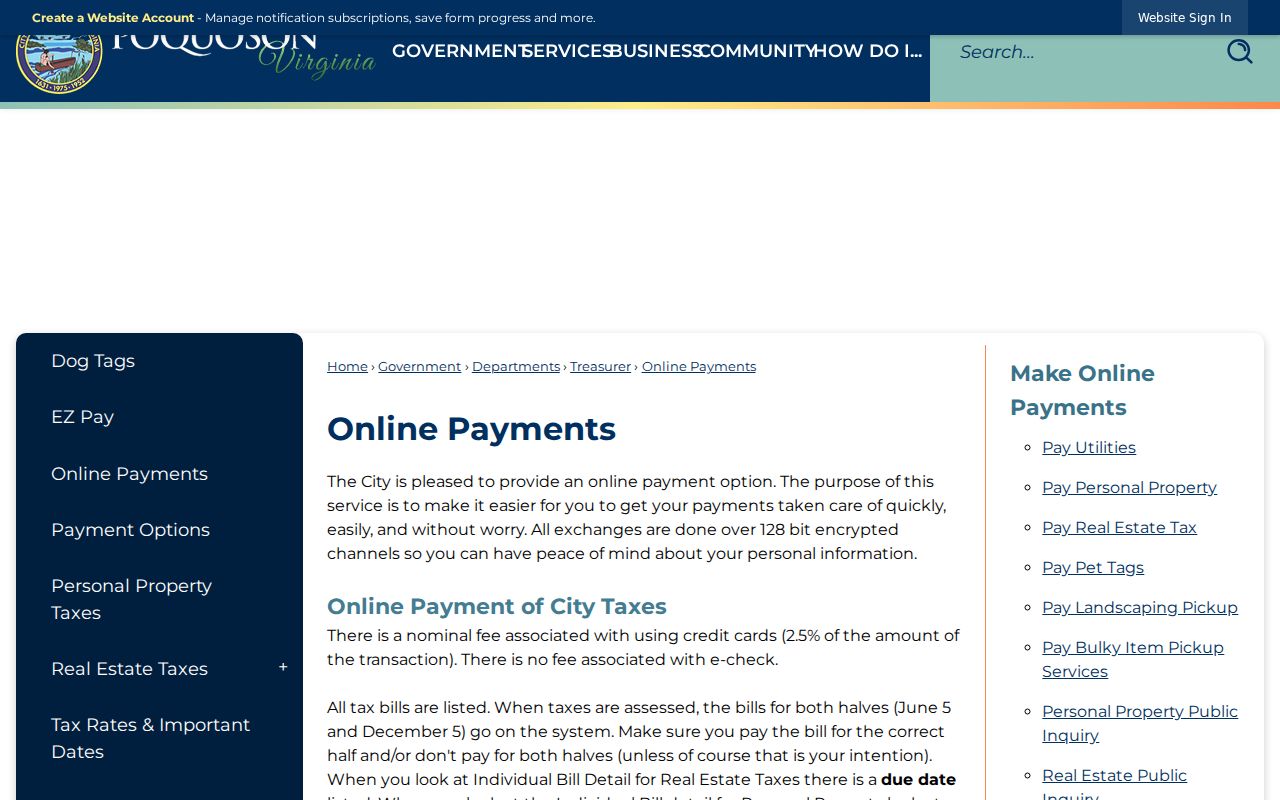
Save your payment confirmation and check the history. If the balance does not change as expected, contact the Treasurer rather than sending a second payment against the same ticket.
Poquoson Property Tax Records and Assessment-Card Access
Virginia Code §58.1-3331 opens local assessment cards and appraisal sheets to public inspection after each reassessment notice, subject to the law's confidentiality exceptions. Confidential taxpayer material stays protected elsewhere in Virginia law. A taxpayer may also examine the working papers behind the appraised and assessed value of that parcel's land and improvements. Ask the Assessor about a specific parcel. Ask also whether a copy is available.
The city's assessment system describes familiar categories like owner of record, mailing address, situs, land value, improvements and last sale, with some details redacted. Labels can vary between cards. Do not assume a fixed layout. A value figure also needs its effective date and property description to mean much. Verify every field on the document itself.
The Virginia assessment-card inspection statute page sets out the public-inspection rule. That page is the statute, not a Poquoson card. The Assessor can explain how the local assessment record is made available.
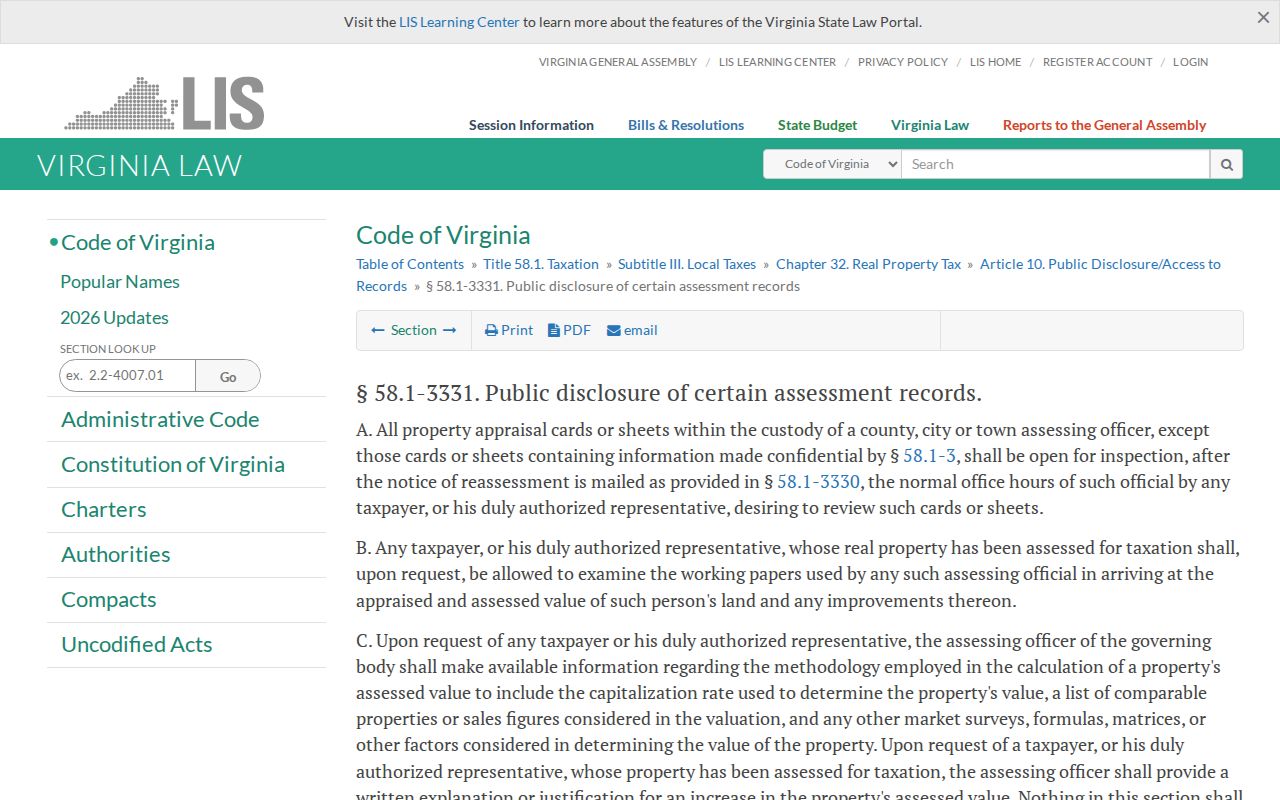
Keep confidential taxpayer details out of anything you publish or repeat. Use the inspection right to understand the assessment, and route corrections to the city custodian.
Ask About Annual Tax Relief and Other Exemptions
Poquoson's tax page describes relief for older or disabled residents. It notes that filing is annual. The current income, asset, age, disability, ownership and filing thresholds are not stated there. No complete list of statutory exemptions or award amounts appears. Rules can be narrow.
Contact the Commissioner of the Revenue or the Assessor for the current application and its supporting documents. Do not rely on an old notice or a neighbor's outcome.
Relief changes the amount due under the program's rules. It does not change the recorded deed or establish the owner of record. An exemption can also make two similar assessed parcels carry different tax bills. Keep the assessed amount, the taxable amount and the final charge separate when comparing parcels.
The Commissioner of the Revenue handles land-book and address-transfer work along with tax-relief administration. The city service directory lists 757-868-3020 for that office; the Assessor is 757-868-3080. Ask which office takes the form. Ask the annual deadline and how a grant shows up on the tax bill.
Appeal the Assessment Through the Assessor
An assessment appeal targets the city's estimate of value or the property facts behind it. It does not challenge the tax rate. Poquoson's Assessor offers value-review appointments and mails reassessment notices on a biennial schedule. Assemble the notice first. Add the parcel description, dated sales evidence and corrections to the property characteristics. Then ask the Assessor what administrative review and appeal steps currently apply.
A precise deadline, form, hearing sequence and evidence rules must come from the city. Never infer a deadline from a neighboring locality. Never lift one from an old reassessment calendar. Confirm the date printed on your notice. City sales reports can supply context, but categories, sale dates, property condition and comparability all matter.
For the tax amount after assessment, contact the Treasurer. For the assessment itself, contact the Assessor. That division keeps an appeal from landing on the desk that merely collects payments.
Poquoson Tax Records Do Not Prove a Clear Title
A Poquoson tax record tells you a lot, but not everything. The Treasurer's inquiry works by name, account, parcel, or street address. It can go beyond the current bill, too. Payment history and ticket detail are available. It also projects the date when penalty and interest charges begin to accrue. An assessment card adds the municipal value the city has placed on the parcel. Still, none of that substitutes for the newest deed. The Commissioner of the Revenue updates ownership from recorded deeds and wills. Billing changes and the assessor's biennial valuation run on their own separate tracks.
Knowing which office answers which question saves time. To confirm who owns a property in Poquoson, use the latest deed. Set the tax record beside it. That deed is recorded with the Circuit Court Clerk. Delinquent tax questions go to the Treasurer, and value disputes go to the Assessor. Boundary questions belong to the recorded plat and a licensed surveyor. A written request under Virginia FOIA can obtain an existing public document. No office must build a fresh calculation or title report for you.
Use the right record. A tax payment is not a transfer, a bill is not a deed and a valuation is not an appraisal. Verify the official record with the Poquoson custodian.
A Poquoson tax lien attaches to the land itself. One paid installment does not clear every earlier charge. Because delinquency can reach back past the current tax bill, an owner or purchaser should work through the Treasurer and a closing professional before assuming the property tax records show a clean slate.
The City of Poquoson tax page publishes the assessment date, the rate, and the installment schedule. Review the official real-estate tax rules for the current figures.
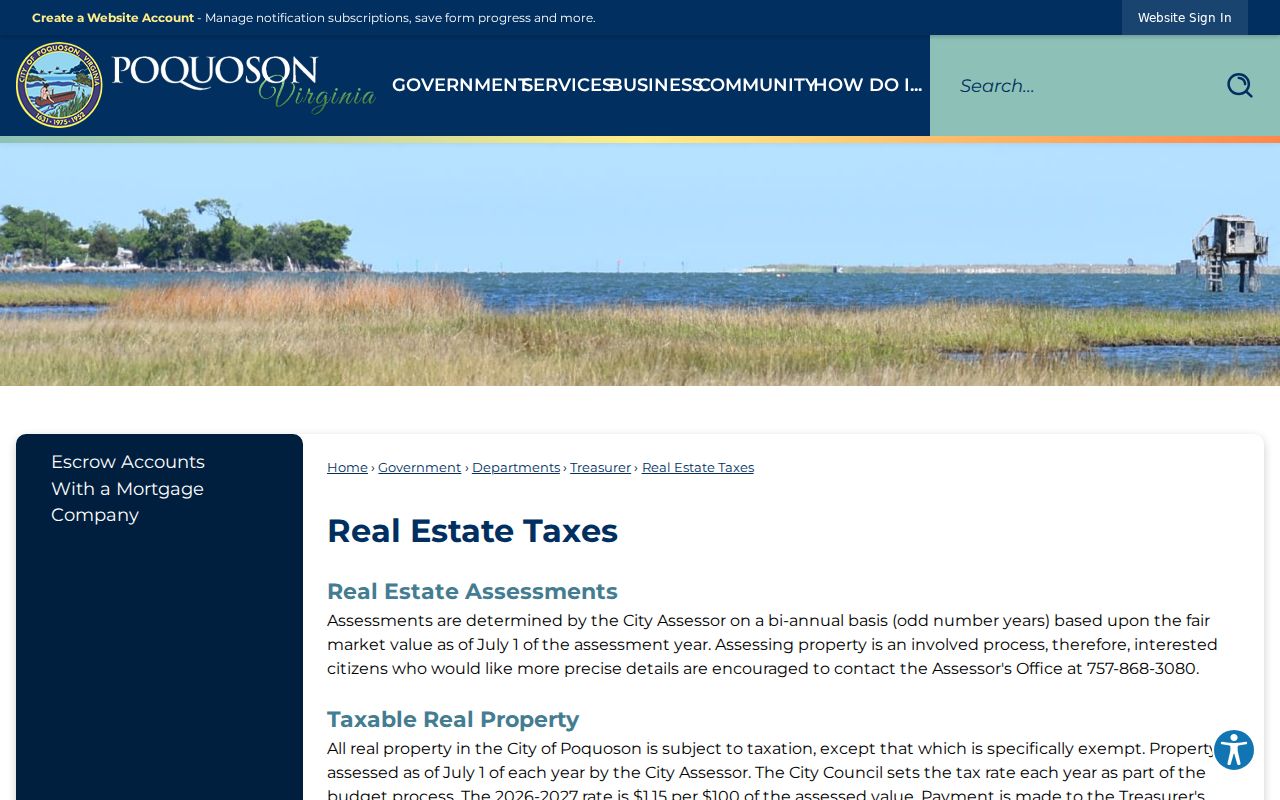
Match those dates to the tax year printed on the bill. Any later change to the schedule should be confirmed with the Treasurer's office.