
Start a Poquoson Property Search With the Treasurer
The City Treasurer's Real Estate Public Inquiry is the clearest public property search Poquoson offers. Four modes appear: Name, Account Number, Parcel Number, and Street Name. Pick the route that fits the clue in hand. Know the road but not the account? Use street mode. A tax statement in front of you makes account or parcel mode safer, since similar street addresses cause mix-ups. Checking a recorded transfer? Treat the Treasurer result as a starting key, not final title evidence.
- Select the Name, Account Number, Parcel Number or Street Name mode that fits your information.
- Enter the requested name or identifier. For Name, the instructions ask for the last name before the first name.
- For Street Name, enter only the road name and leave off the street number so the inquiry can list matching accounts along that street.
- Add a projected date only if you need a penalty-and-interest calculation; otherwise the application uses the current date.
- Review matching records, select the relevant name or account, and follow the payment-history screen to ticket detail.
Copy the account or parcel reference exactly as the official system shows it. Then compare it with the City Commissioner's parcel record or map number, and use that cross-reference when you want the assessment, the GIS view, or the newest deed. This sequence anchors a Poquoson property search. The city's public pages offer no single combined owner, address, and deed lookup.
Poquoson Street-Name Property Search Lists a Road’s Accounts
The Treasurer's instruction is unusually specific: type the street name without the street number. That helps when an address is incomplete, when several parcels sit on one road, or when an older record uses a road name instead of a modern house number. It does not mean every row is a physically adjacent parcel. The list reflects tax accounts tied to the street, and a creek, road, or locality boundary can separate properties that look close on a map.
Say you hold a Poquoson Avenue reference. Try the street-only mode, inspect the matching names, and use the listed parcel clue to isolate the target. Do not invent a parcel prefix or borrow number formatting from York County or Hampton. Poquoson's public instructions call the identifier a parcel number but never publish its exact syntax.
The official Real Estate Public Inquiry instructions display the street-name rule and the search controls. After reviewing the matches, confirm the chosen parcel with the Treasurer or Commissioner when two accounts could fit.
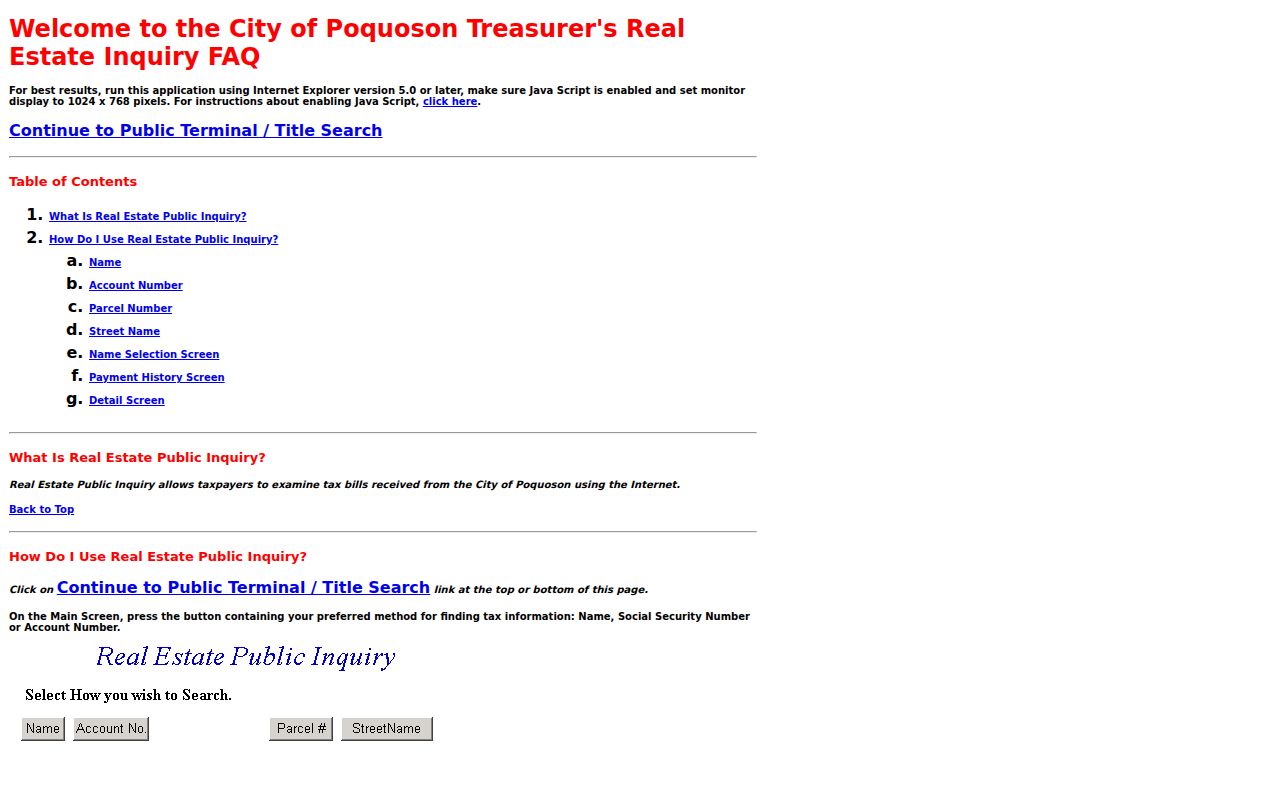
Treat street mode as a shortlist builder. It is not a GIS neighbor tool, and the tax inquiry confirms no surveyed address point or property line.
Name-Based Poquoson Property Search Starts With Last Name
Name mode asks for a last name first, then a first name. The date field is optional. A name-selection screen appears before payment history. So never assume the first matching person owns the right parcel. Names repeat across a small city. A taxpayer account can also carry a mailing address different from the land's location.
Try alternate spellings or initials only when a source record genuinely shows a variant. When an LLC or trust appears in a deed, use the exact legal name. Take it from the recorded instrument. A personal name on a tax account is a useful lead. The public instructions do not reveal every field in ticket detail. They also do not say whether partial-name searches work. So ask the Treasurer to clarify an ambiguous match.
The Commissioner of the Revenue keeps the parcel record. The office assigns map numbers and transfers property based on a deed or will. It updates owner addresses and assessment changes for billing. It also produces the annual Real Estate Land Book. The Commissioner publishes no public owner-name assessor form. The Treasurer's name mode is a verified entry point. It is not proof it reaches every beneficial owner or fiduciary.
Read the Result Screens in a Poquoson Property Search
The public instructions describe three result stages. The Name Selection Screen lists matches for your criteria. Choosing a match opens the Payment History Screen. Choosing a ticket opens a detail screen. The instructions say that detail view holds more information about the ticket. Exact field labels stay unlisted, though. Trust the named screens as documented behavior. Avoid promising fields you have not confirmed on a live account.
| Screen or control | What the instructions establish | How to use it |
|---|---|---|
| Search mode | Name, Account, Parcel or Street | Choose the closest known key |
| Name Selection | Lists matching records | Compare identity and property clues before selection |
| Payment History | Lists entries for the selected name | Review account history, not title status |
| Ticket Detail | Shows more detail for a selected ticket | Verify balance or payment with Treasurer |
| Projected Date | Optional penalty and interest date | Leave blank for the application’s current date |
The legacy Poquoson search screen keeps things spare. Buttons run Search, Select, Previous, and Return to Search. There is no download, export, or page-range navigation. Help text still cites Internet Explorer 5 and a 1024-by-768 display, so the old instructions trail far behind any current browser. If a control fails, the record has not vanished. Use the newer city payment entry, or call the Treasurer, rather than concluding the parcel is missing.
The city's e-Treasurer landing page is the newer route for online inquiry and payment. It handles real-estate inquiry plus lookup by department or ticket number, parcel, name, or account. Result detail stays account-specific. Confirm what you need there.
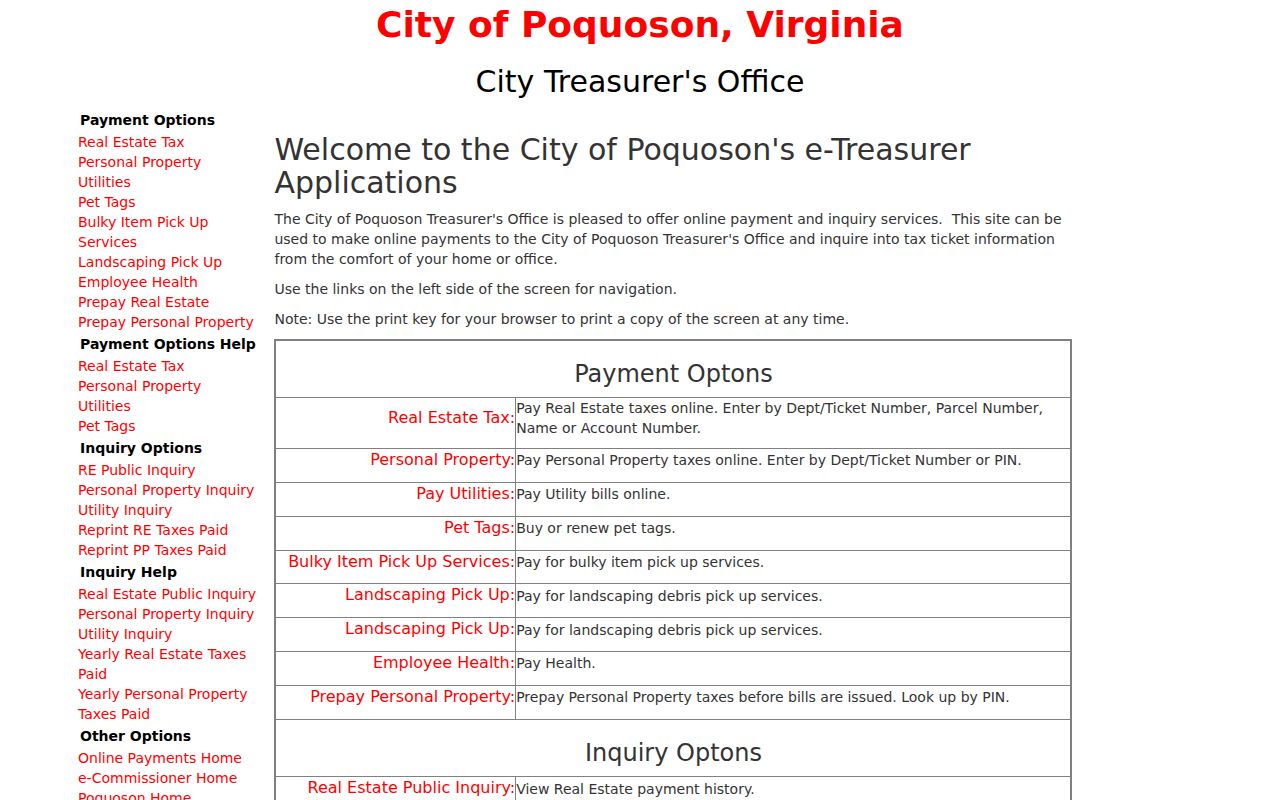
Reach Poquoson inquiries and payments through the newer entry point. A payment page, though, is no deed repository.
Poquoson Property Search: Separate Situs From Tax Mailing
A situs address and a tax mailing address answer two different questions. The situs fixes where the land sits. The mailing line says where bills go. Because the Commissioner updates owner addresses for billing, that destination can change without any transfer of title, pointing to an owner's home elsewhere, a care-of contact, a lender, a representative, or an estate.
Bridging systems takes the legal description. The map or parcel number works too. Older deeds resist modern spelling. A renamed road or a historic name may be the only bridge to an older instrument. Keep the situs exactly as shown. Then try a period-appropriate street name if the first search stalls. ZIP Code 23662 covers Poquoson in official city material. USPS still governs delivery geography, and a ZIP is never a legal boundary.
Timing matters too. A fresh deed can outrun billing. Until the account updates, the newest transfer stays invisible. The deed's recording date and legal description anchor ownership research far better than a mailing line or any name list.
Carry a Parcel Number From Poquoson Property Search to the Deed
When a result identifies a candidate account, note the parcel number, map number, situs, owner name and record date exactly as displayed. The city describes the Commissioner’s map number as a cross-reference key, and it links the parcel record to the Land Book and later deed or will transfer. If a field label is not shown, ask the office rather than relabeling another number as a map number.
For value, use the Assessor page and sales reports. The city reassesses biennially in odd-numbered years, values property as of July 1 of the assessment year, and assesses new construction when it occurs. The published fiscal 2026–2027 real-estate tax rate is $1.15 per $100. These details explain why an assessment or bill may answer a different question from the last recorded sale.
For title, use the Circuit Court Clerk’s COVERS land-record route and verify the instrument with the Clerk. Search the newest deed using the present grantee and legal description. A tax account can point to a likely owner, while a recorded deed documents a transfer. The Poquoson deed-record guide explains the grantor-grantee route in more detail.
Use Sales Reports as a Separate Search Layer
The Assessor's public sales reports come in four flavors: residential, commercial, land, and all sales. Each report is its own layer. The current set runs from January 1, 2022 through June 30, 2026. The page posts its own refresh date, April 28, 2026. The city also warns that assessment data carries no warranty and cannot be resold without a sublicensing agreement.
Compare numbers with care. Keep the sale date and class beside any figure. A vacant-land sale is not a house transfer. A recorded consideration says nothing about current condition, improvements, easements, or waterfront constraints. Search by parcel first, then weigh the report's category and timeframe. The report cannot set present market price. The Assessor handles questions about assessment review.
The official Real Estate Sales page lists its categories and date range; use it beside a current assessment and a recorded deed, not in place of either.
When the Search Reaches an Older York County Record
Poquoson spent most of its history tied to York County. It became an independent city only in 1975. Because of that split, a Poquoson property records search can stop short of the earliest links in a chain of title. Deeds recorded before the change sit under the former jurisdiction. Note the locality and time period for every result you collect.
The Circuit Court Clerk can tell you which deed books and indexes cover a given tract. Older indexes rarely work by street address. Search grantors, waterways, farm names, and adjoining owners instead. Local history supplies useful alternate terms too. These include older names tied to Poquoson Avenue, Forrest Road, Hudgins Road, and Wythe Creek Road. Confirm the exact road segment and date before substituting a historic name. A deed description may cite a creek, a marsh, or a neighbor's land. A modern tax search expects an address. A plat or a metes-and-bounds description can bridge that gap.
For historical context, several institutions are strong leads. The Library of Virginia catalogs, Virginia Memory, the Poquoson Museum, and the public library all hold useful material. Ask each institution directly about its directory coverage and microfilm holdings. Old photographs can pin down a building or place name. Ownership itself, though, always comes back to the recorded instrument held by the clerk.
Poquoson Property Search Limits and Follow-Up
A Poquoson property search result is a starting point. It can surface a tax account, payment history, a probable parcel connection, or a public sales report. It cannot certify title. It will not reveal every person behind a trust or company, settle a boundary dispute, or prove a current sale value. The state's COVERS system draws on remote information, so treat it as a pointer rather than the official record. Assessment data carries confidentiality protections as well, and the city systems do not document every available field or search function, so confirm specifics with the office that maintains the data.
When a match stays unresolved, call the Treasurer at 757-868-3015, the Commissioner of the Revenue at 757-868-3020, the Assessor at 757-868-3080, or the relevant Clerk's office. Permit and zoning history belong to the Permit Office at 757-868-3035 and Community Development at 757-868-3040. A VFOIA request can obtain an existing public record from its custodian. The office is not obligated to create a new search or analysis on request.
Use the record for property research. A tax inquiry is not a title search and a street list is not a survey. Do not use owner information to stalk, threaten or harass a person.
Some decisions deserve more than a database result. A purchase, an estate, a property line, or an assessment appeal all qualify. Bring the instrument, the parcel identifier, and the report date to the right professional: a title expert, surveyor, tax official, or city custodian for direct verification.