
Poquoson Property Value: Three Numbers, Three Meanings
Name the kind of number before you use it. An assessment is a municipal estimate built for taxation. A sale price is the consideration recorded on a past deed, while market value is a broader estimate of what a parcel might sell for under stated conditions at a given time. An appraisal is different still: a professional valuation prepared for a specific purpose. Each figure draws on its own sources, dates, and methods. Substituting one for another leads to bad comparisons.
| Value term | What it means | Where Poquoson evidence appears |
|---|---|---|
| Assessed value | City estimate of probable selling price for taxation | Assessor assessment record / notice |
| Recorded sale | Price or consideration associated with a past transfer | City sales reports and deed instrument |
| Market value | Estimated current exchange value under stated assumptions | Comparable analysis or appraisal, not a single city field |
| Taxable amount | Value after applicable tax treatment or relief | Assessment and tax account, details vary |
Ask the city for the property-specific assessment card. Note its effective date when you read it. A recorded sale amount, meanwhile, says nothing about current condition, unrecorded improvements, easements, or water-related limits on the parcel.
Poquoson Assessed Value Uses a July 1 Date
The City Assessor states that value is an estimate of probable selling price and that similar properties are appraised on an equal basis. General reassessment is biennial, in odd-numbered years, with fair market value as of July 1 of that assessment year. New construction and improvements are assessed when they occur. That date and cycle explain why an assessment may differ from a later sale or a recent renovation.
The Assessor mails general-reassessment notices and offers value-review appointments. To understand a particular number, compare the notice date, valuation date, parcel description and property characteristics. If an improvement or land feature has changed, ask how it is reflected in the record. The reviewed sources do not give a per-card owner/value field list or the current appeal deadline, so confirm those details with the city.
The official Poquoson Assessor page describes the valuation approach and links to mapping and sale data. Its captured page is shown below. An overview page is not an individual appraisal card, so request the specific parcel record for exact information.
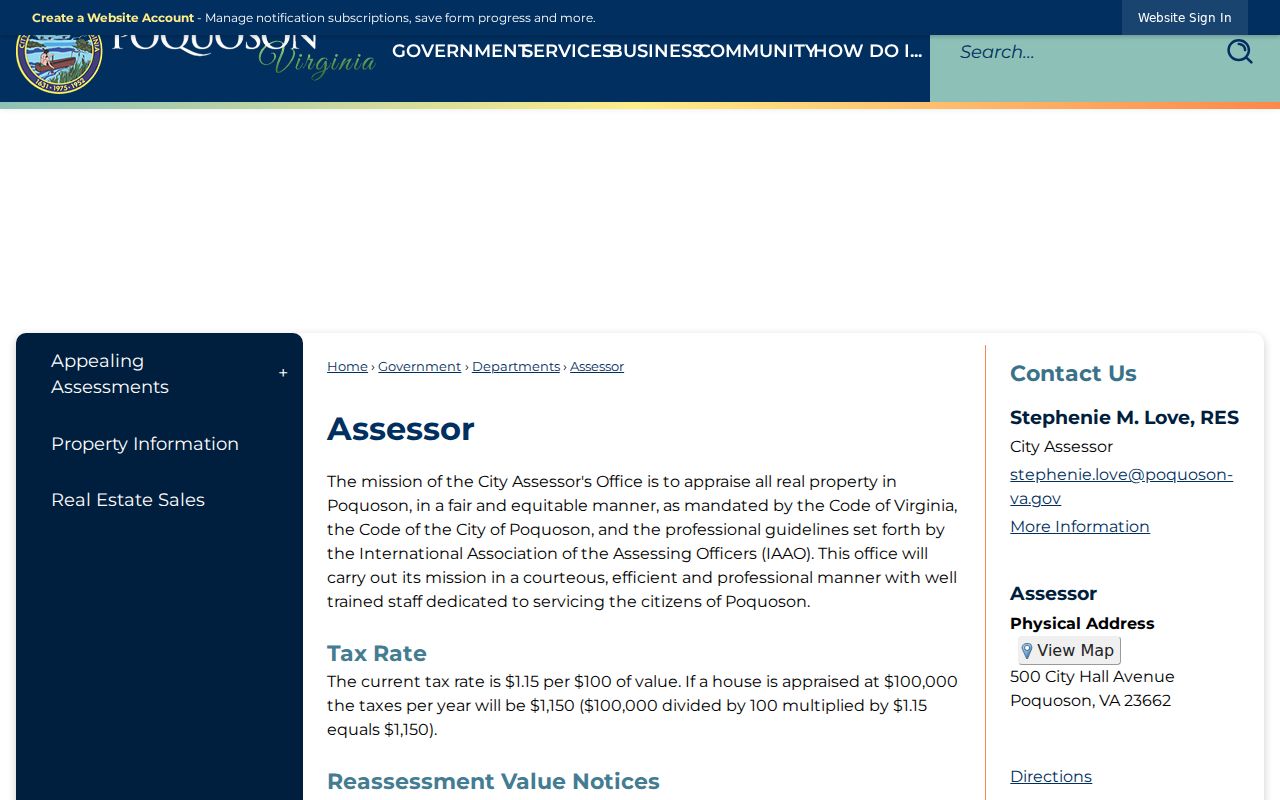
Keep the city's stated valuation date beside any assessed amount you compare against an outside estimate.
Poquoson Property Value Changes With New Construction
Poquoson assesses new construction and improvements when they occur, outside the odd-year reassessment cycle. That creates two timing layers: a citywide revaluation date and a property-specific change. The property-specific change is tied to construction. A new improvement can shift the assessed figure without any sale taking place. A sale can also close after the valuation date. No immediate citywide revaluation follows it.
When reviewing a property, identify the source of the number. It comes from either the general reassessment or a new-construction update. Ask the Assessor how the change was dated and which property details fed into it. Do not treat a new tax figure as a market appraisal.
Permit files add context to visible improvements. The city Permit Office lists building, trade, driveway, right-of-way, land-disturbing, and elevation-related applications. A permit approval explains construction history, but it sets no value and proves no title.
Poquoson Property Value and the Tax Rate
For fiscal years 2026 through 2027, the city publishes a real-estate tax rate. The rate is $1.15 per $100 of assessed value. The rate explains a tax calculation. It does not define market value. A tax bill also reflects the tax period and the account treatment that applies. The assessment is the valuation input; payment status and due dates belong to the Treasurer.
Keep the rate, the assessment year, and the valuation date separate. Note any relief or exemption status as well. Program eligibility thresholds vary, so do not estimate a household's bill from a neighbor's property. A person disputing an assessment should speak with the Assessor. Questions about a charge or a payment go to the Treasurer.
The city's tax page lists the $1.15 rate. It also shows June 5 and December 5 installment dates for the current period. Detailed bills, payment fees, and delinquency rules appear on the Poquoson property tax records page. Those are tax-account questions rather than valuation definitions.
Poquoson Property Value Reports Show Dated Sales
Poquoson splits its real estate sales data into residential, commercial, land, and all-sale reports. Coverage runs from January 1, 2022 through June 30, 2026. An update notice on the report page is dated April 28, 2026. Those dates apply only to the sales set. Assessor cards and deed images may carry different coverage. Check each source before quoting a price. The city also notes that assessment data carries no warranty. It cannot be resold without a sublicensing agreement.
Treat a sales report as market context rather than proof that a subdivision appreciated. Sound comparisons need matching property type, transaction period, and physical traits. Poquoson publishes no verified neighborhood trend and names no fastest-changing area. Waterfront position, land versus improvements, and permit history can make two nearby parcels poor comparables. The official sales-report page holds the dates and categories. Its screenshot identifies the report page and its update notice. Read each report's scope before citing any single price.
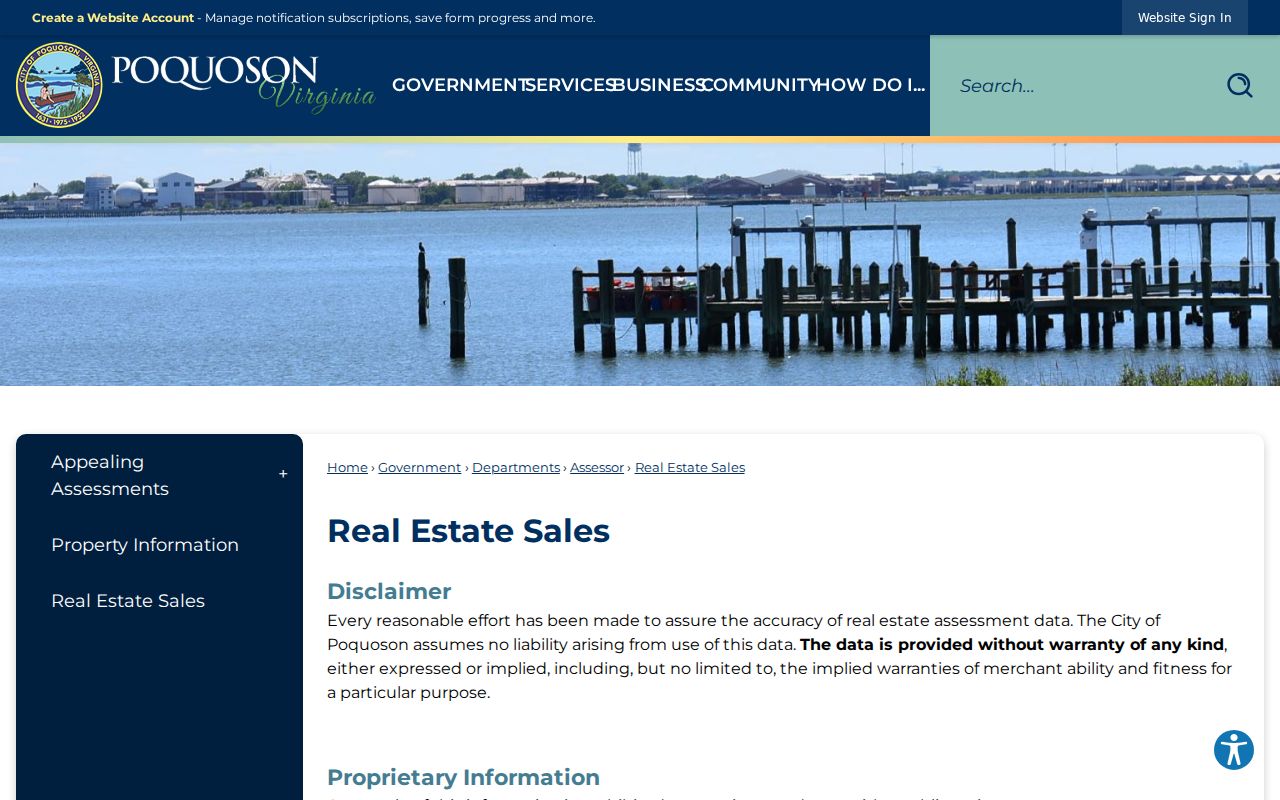
A dated sale is evidence of a past transfer, nothing more. The recorded deed supplies the conveyance context, while setting a present value is a separate job for an appraisal or market analysis.
Poquoson Assessed Value, Land and Improvements
Assessment systems often split land from improvements, but Poquoson's card labels are not shown here. Ask the Assessor what components appear on the property records for a given parcel. Confirm how the valuation date applies. Never estimate a land and improvement split from a public sales report. A map's acreage label is not the assessed area.
Tax relief can change a tax bill without touching the deed transfer. Poquoson's tax page describes relief for older or disabled residents with annual filing. Current income, age, and award thresholds come from the Commissioner of the Revenue or Assessor. Keep assessed value, taxable treatment, and amount due as three distinct figures. Virginia Code §58.1-3331 permits inspection of assessment cards and specified working papers after a reassessment notice. The inspection is subject to confidentiality rules. The card explains the city's valuation inputs. It does not promise what a buyer will pay.
Assessment Review Uses Comparable Evidence, Not a Guess
The Poquoson Assessor offers value-review appointments. An owner who thinks the assessment misses the city's probable-selling-price standard should gather the notice, valuation date, parcel description, and comparable sales. Match comparables by property type and period. A land-only report is not a house sale. Ask the Assessor for the current appeal sequence and deadline.
The real question is whether the value record holds up for its valuation date, not whether a later buyer can land a certain price. Tax rate changes are policy matters, separate from a parcel review. Sales reports supply evidence. They do not decide the appeal outcome. For bill amounts, installments, or payment history, the Treasurer is the right office. Keeping that division clear prevents arguing an assessment question with the bill collector.
Poquoson GIS and Sales Data Have Limits
The Assessor links to the city's GeoPlan mapping site. The exact Poquoson project URL, layers, and display fields are not posted here. Open the GIS map and look. A parcel polygon can orient a comparison. But it is no boundary survey and does not vouch for the assessment's acreage. The city sales page carries a warranty and resale notice. Preserve the source and date of any map or report. Ask the city before republishing data.
Poquoson's shoreline and Chesapeake Bay setting shape what can be built. Tidal wetlands, RPA and RMA buffers, drainage rules, elevation certificates, and WQIA review can constrain a project. A value number hides these limits. A permitted improvement, flood requirement, or marsh adjacency may explain why two nearby assessments differ. The city permit and environmental offices confirm the relevant file.
Use the Assessor record for exact value. Use the deed and sales report for a transfer price. Use the Treasurer for a tax charge. Use a recorded plat and licensed surveyor for a boundary. No single figure answers all four questions.
What a Poquoson Property Value Does Not Promise
An assessed value exists for taxation. It is not an appraisal. It does not guarantee a sale price, certify title, or fix a parcel boundary. A sales report is historical and category-specific. A tax amount reflects the rate and the account's treatment. When figures disagree, compare their dates, definitions, and source. Avoid grabbing the largest or newest-looking number.
Assessment is not an appraisal. Poquoson’s assessed amount is the city’s estimate for taxation. For a sale, lending, estate or dispute purpose, use the relevant qualified valuation professional and confirm underlying records with the city.
The City Assessor, Commissioner, Treasurer, and Circuit Court Clerk each hold a different piece of the evidence. A buyer or owner should verify the particular property records with the custodian. A valuation professional should interpret comparable sales whenever a market conclusion matters.
For the official current rate and installment schedule, consult the City of Poquoson real-estate tax page, and keep its tax-period details separate from any value estimate.